
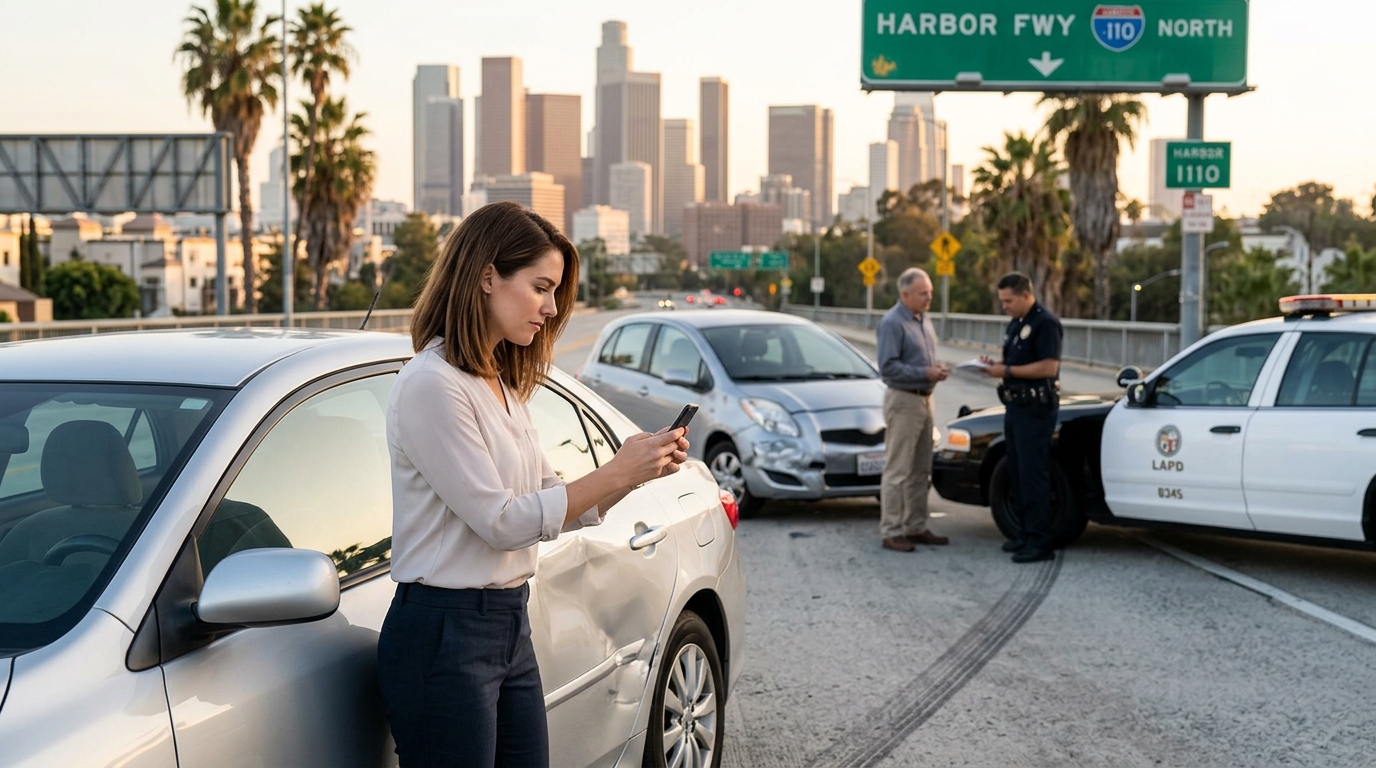
Being involved in a motor vehicle collision on busy Southern California roadways—whether on the I-405, the I-110, or a local intersection in Los Angeles—is disorienting and stressful. In the minutes and days following a crash, the steps you take directly impact both your physical recovery and your legal right to financial compensation.
Insurance companies look for any reason to minimize or deny injury claims. By following this step-by-step legal and medical guide, you can protect your health, preserve critical evidence, and safeguard your claim under California law.
Step 1: Prioritize Safety and Call 911 Immediately
Your immediate priority after any crash is physical safety.
-
Move Out of Traffic: If your vehicle is drivable and it is safe to do so, pull over to the shoulder or a nearby side street to prevent secondary collisions. Turn on your hazard lights.
-
Check for Injuries: Check yourself, your passengers, and others involved for injuries. Do not attempt to move anyone who is unconscious or complaining of severe neck or back pain unless there is an immediate fire hazard.
-
Call 911: Always request law enforcement and paramedics, even if the damage looks minor. An official police report from the Los Angeles Police Department (LAPD) or California Highway Patrol (CHP) serves as vital, objective documentation of how the collision occurred.
Step 2: Document the Scene and Gather Evidence
Before vehicles are towed and witnesses leave, gather as much evidence as possible using your smartphone.
-
Photograph and Record Everything: Take wide-angle and close-up photos of all vehicles involved, license plates, skid marks, broken glass, traffic signals, road hazards, and visible bodily injuries.
-
Exchange Information: Collect the other driver’s full name, phone number, home address, driver’s license number, license plate number, and auto insurance policy details.
-
Speak to Witnesses: Independent eyewitnesses can make or break a disputed liability claim. Ask bystanders for their names and phone numbers before they leave the scene.
-
Look for Nearby Cameras: Note if nearby businesses, intersections, or passing vehicles (dashcams) may have captured the collision on video.
Step 3: Seek Prompt Medical Evaluation
Adrenaline and shock frequently mask pain immediately after a car crash. Symptoms of whiplash, concussions, traumatic brain injuries (TBIs), internal bleeding, and soft-tissue damage often take 24 to 72 hours to appear.
-
Get Examined Right Away: Visit an emergency room, urgent care center, or your primary physician the same day or within 24 hours of the accident.
-
Follow Your Treatment Plan: Attend all follow-up appointments, physical therapy sessions, and diagnostic imaging tests (such as X-rays or MRIs). Insurance adjusters routinely use gaps in medical treatment to argue that your injuries were not serious or were caused by something else.
Step 4: Report the Accident to the California DMV (Form SR-1)
Many drivers do not realize that California law imposes a strict reporting requirement separate from calling the police.
Under California Vehicle Code § 16000, you—or your attorney—must file a Report of Traffic Accident Occurring in California (Form SR-1) with the Department of Motor Vehicles within 10 days of the collision if:
-
Anyone was injured (even slightly) or killed, OR
-
Property damage exceeds $1,000.
Failing to file Form SR-1 on time can result in the suspension of your driver’s license, regardless of who caused the accident.
Step 5: Be Cautious When Speaking to Insurance Adjusters
You are required to notify your own insurance company that an accident occurred, but you should exercise extreme caution when speaking with any insurance representative—especially the at-fault driver’s insurer.
-
Stick to the Basic Facts: Provide only the date, time, location, and vehicles involved.
-
Never Admit Fault: Avoid saying “I’m sorry” or guessing about speed or distances. California follows a pure comparative negligence rule, meaning any percentage of fault attributed to you will reduce your financial recovery.
-
Decline Recorded Statements: Do not agree to give a recorded statement or sign medical release authorizations until you have spoken with a qualified personal injury attorney. Adjusters are trained to ask leading questions designed to devalue your claim.
Step 6: Consult a Los Angeles Personal Injury Attorney Before Accepting a Settlement
Insurance companies often reach out within days of a crash with a fast, lowball settlement offer. Accepting early cash requires you to sign a release waiving all future claims—leaving you stuck paying out-of-pocket if you later need surgery, ongoing therapy, or time off work.
An experienced personal injury lawyer will handle all communication with insurance companies, gather police and medical records, calculate the true lifetime value of your damages (including medical bills, lost wages, and pain and suffering), and fight for maximum compensation.
Frequently Asked Questions (FAQs)
How long do I have to file a car accident lawsuit in California?
Under California Code of Civil Procedure § 335.1, you generally have two years from the date of the accident to file a personal injury lawsuit. However, if a government vehicle or poorly maintained public road caused your crash, you must file an administrative government claim within six months.
What if the driver who hit me has no insurance?
If you were hit by an uninsured or underinsured motorist (or in a hit-and-run), you may still recover compensation through your own auto policy if you carry Uninsured/Underinsured Motorist (UM/UIM) coverage. An attorney can review your policy to identify all available sources of recovery.
How much does it cost to hire a personal injury lawyer?
At Ellias Law, PC, we represent injured victims on a contingency fee basis. You pay zero upfront fees, and we only get paid if we successfully recover compensation for your case.
Injured in a Los Angeles Car Accident? Contact Ellias Law, PC Today
You do not have to take on powerful insurance companies alone. Ellias Law, PC, a Los Angeles personal injury law firm, is dedicated to protecting accident victims in Southern California, providing aggressive advocacy and compassionate support.
If you or a loved one was injured in a collision, contact Attorney George A. Ellias today for a free, no-obligation consultation to review your rights and legal options.
-
Office Phone: (877) 700-1020
-
Website: www.elliaslaw.com
-
Email: info@elliaslaw.com
Disclaimer: The information provided in this blog post is for general informational purposes only and does not constitute formal legal advice. Reading this article does not establish an attorney-client relationship. Every case is unique; consult a licensed California attorney regarding your specific situation.