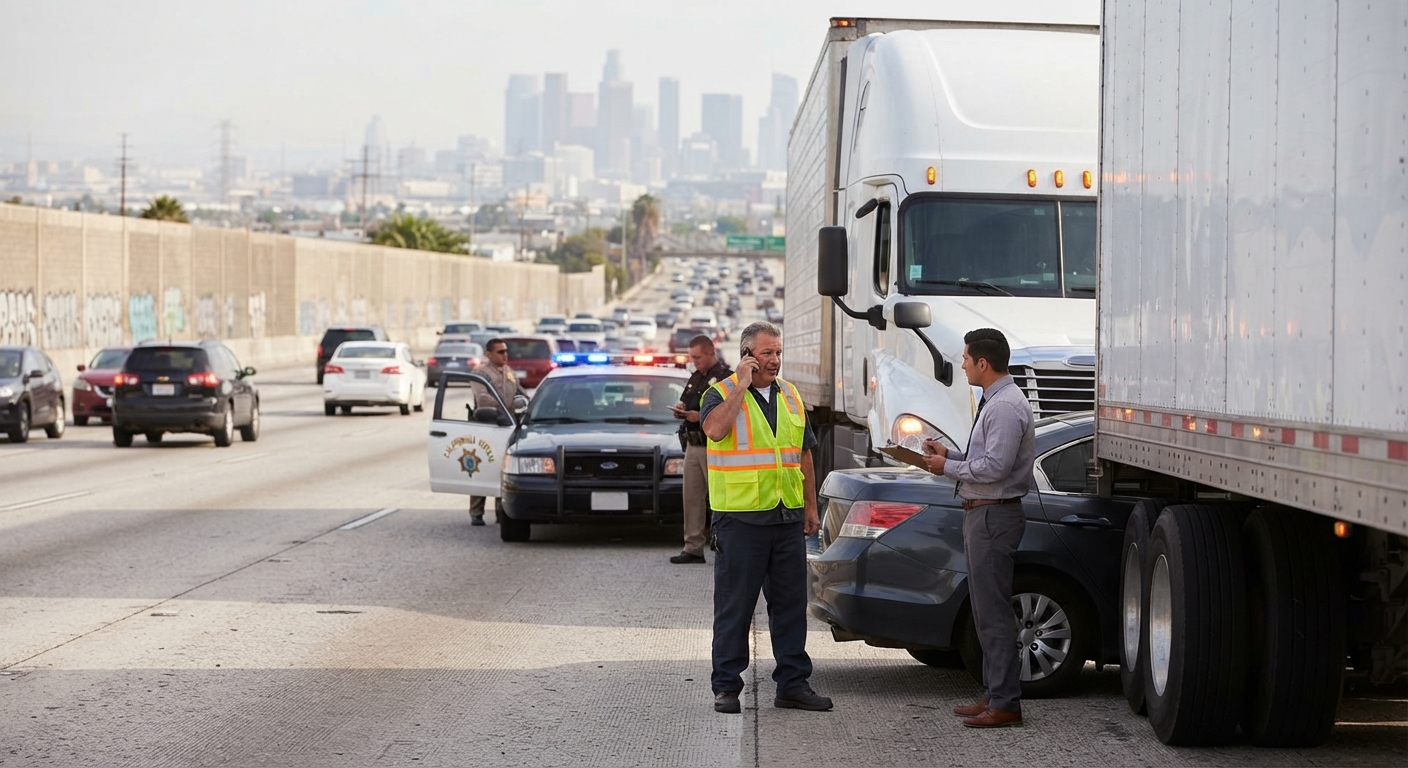
Collisions involving commercial semi-trucks, 18-wheelers, and delivery rigs on Southern California’s major freight corridors—such as the I-710, I-405, I-10, and I-5—are vastly different from standard passenger car crashes. Because a fully loaded commercial tractor-trailer can weigh up to 80,000 pounds, the resulting injuries are often catastrophic.
Beyond the severity of the injuries, commercial truck accident claims involve complex webs of federal regulations, corporate insurance policies, and multiple potentially responsible parties. Identifying every liable party is critical to securing the full financial compensation you need for medical care, lost earning capacity, and long-term recovery.
Why Commercial Truck Liability Is More Complex Than a Car Crash
In a typical car accident, liability usually rests with one negligent driver. In a commercial trucking collision, the driver is rarely the only party responsible. Commercial trucking is governed by both California state traffic laws and strict federal rules enforced by the Federal Motor Carrier Safety Administration (FMCSA).
When a crash occurs, trucking companies and their commercial insurers immediately dispatch rapid-response investigators to the scene to limit their financial exposure. Holding them accountable requires investigating every link in the commercial supply chain.
5 Parties Who Can Be Held Liable in a California Truck Accident
1. The Commercial Truck Driver
A truck driver can be held directly liable when their negligent or reckless actions cause a collision. Common forms of driver negligence include:
-
Driver Fatigue: Violating FMCSA Hours of Service (HOS) limits by driving beyond the maximum allowed daily or weekly hours without mandatory rest breaks.
-
Distracted Driving: Using mobile phones, dispatch tablets, or GPS systems while operating a heavy vehicle.
-
Speeding and Unsafe Lane Changes: Failing to account for wide turning radii, extended stopping distances, and large blind spots (“No-Zones”).
-
Driving Under the Influence (DUI): Operating a commercial vehicle while impaired by alcohol, illicit drugs, or disqualifying prescription medications. Under federal law, commercial drivers face a stricter 0.04% Blood Alcohol Concentration (BAC) limit.
2. The Trucking Company (Motor Carrier)
Under the legal doctrine of respondeat superior (vicarious liability), employers are generally responsible for the negligent acts of their employees committed within the scope of employment. Additionally, a motor carrier can be held directly liable for its own corporate negligence, including:
-
Negligent Hiring and Training: Hiring drivers with suspended commercial driver’s licenses (CDLs), histories of DUI convictions, or poor safety records.
-
Unrealistic Delivery Schedules: Pressuring drivers to speed or falsify electronic logging device (ELD) records to meet tight shipping deadlines.
-
Poor Fleet Maintenance: Failing to conduct required pre-trip and post-trip inspections or neglecting worn brakes, bald tires, and broken lights.
3. Third-Party Cargo Loaders and Shippers
Many commercial trucks carry freight loaded by third-party logistics companies or warehouse teams rather than the truck driver. If cargo is improperly balanced, overweight, or inadequately secured:
-
Shifting freight during a turn or sudden stop can cause the trailer to jackknife or roll over.
-
Unsecured items can spill onto busy Los Angeles freeways, triggering multi-vehicle pileups.
When improper loading contributes to a crash, the shipping or cargo-loading company can share direct legal liability.
4. Maintenance and Repair Contractors
Trucking companies frequently outsource fleet servicing to third-party repair shops. If a maintenance contractor fails to properly repair a braking system, steering mechanism, or trailer coupling—and that failure causes a crash—the maintenance provider may be held liable for negligent repair work.
5. Truck and Parts Manufacturers
Not every mechanical failure is due to poor maintenance. If a collision is caused by a defective tire blowout, faulty brake assembly, or flawed underride guard design, the manufacturer of the truck or the defective component can be held strictly liable under California product liability law.
How Evidence Is Preserved in Commercial Truck Claims
Critical evidence in a commercial trucking case can disappear quickly if legal action is delayed. Under federal regulations, trucking companies are only required to retain certain driver logs and inspection records for limited periods, and electronic vehicle data can be overwritten within days.
An experienced personal injury attorney will immediately issue a formal spoliation letter demanding the preservation of:
-
Electronic Control Module (ECM) / “Black Box” Data: Records vehicle speed, braking patterns, throttle position, and sudden deceleration prior to impact.
-
Electronic Logging Device (ELD) Records: Tracks driving hours, rest periods, and GPS location history.
-
Driver Qualification Files: Contains background checks, drug and alcohol test results, medical examiner certificates, and prior safety violations.
-
Maintenance and Inspection Logs: Documents repair histories and unaddressed mechanical defects.
Frequently Asked Questions (FAQs)
How does California’s comparative negligence law affect a truck accident claim?
California follows a pure comparative negligence system. Even if you were partially at fault for the accident, you can still recover financial compensation—your total award is simply reduced by your percentage of fault.
What damages can I recover after a commercial truck crash?
Depending on the severity of your injuries, you may recover economic and non-economic damages, including past and future medical bills, rehabilitation costs, lost wages, diminished future earning capacity, property damage, and pain and suffering.
How long do I have to file a truck accident lawsuit in California?
Under California Code of Civil Procedure § 335.1, you generally have two years from the date of the crash to file a personal injury lawsuit. However, if a government-owned commercial vehicle (such as a municipal utility truck or transit vehicle) was involved, you must file an administrative claim within six months.
Injured in a Southern California Truck Accident? Contact Ellias Law, PC
Commercial trucking companies and their insurers have teams of lawyers working to protect their bottom line from the moment a crash happens. You deserve dedicated legal representation fighting for yours.
Ellias Law, PC, a Los Angeles personal injury law firm, is dedicated to protecting accident victims in Southern California, providing aggressive advocacy and compassionate support. Contact Attorney George A. Ellias today for a free, confidential consultation to discuss your case.
-
Office Phone: (877) 700-1020
-
Website: www.elliaslaw.com
-
Email: info@elliaslaw.com
Disclaimer: The information provided in this blog post is for general informational purposes only and does not constitute formal legal advice. Reading this article does not establish an attorney-client relationship. Every case is unique; consult a licensed California attorney regarding your specific situation.